

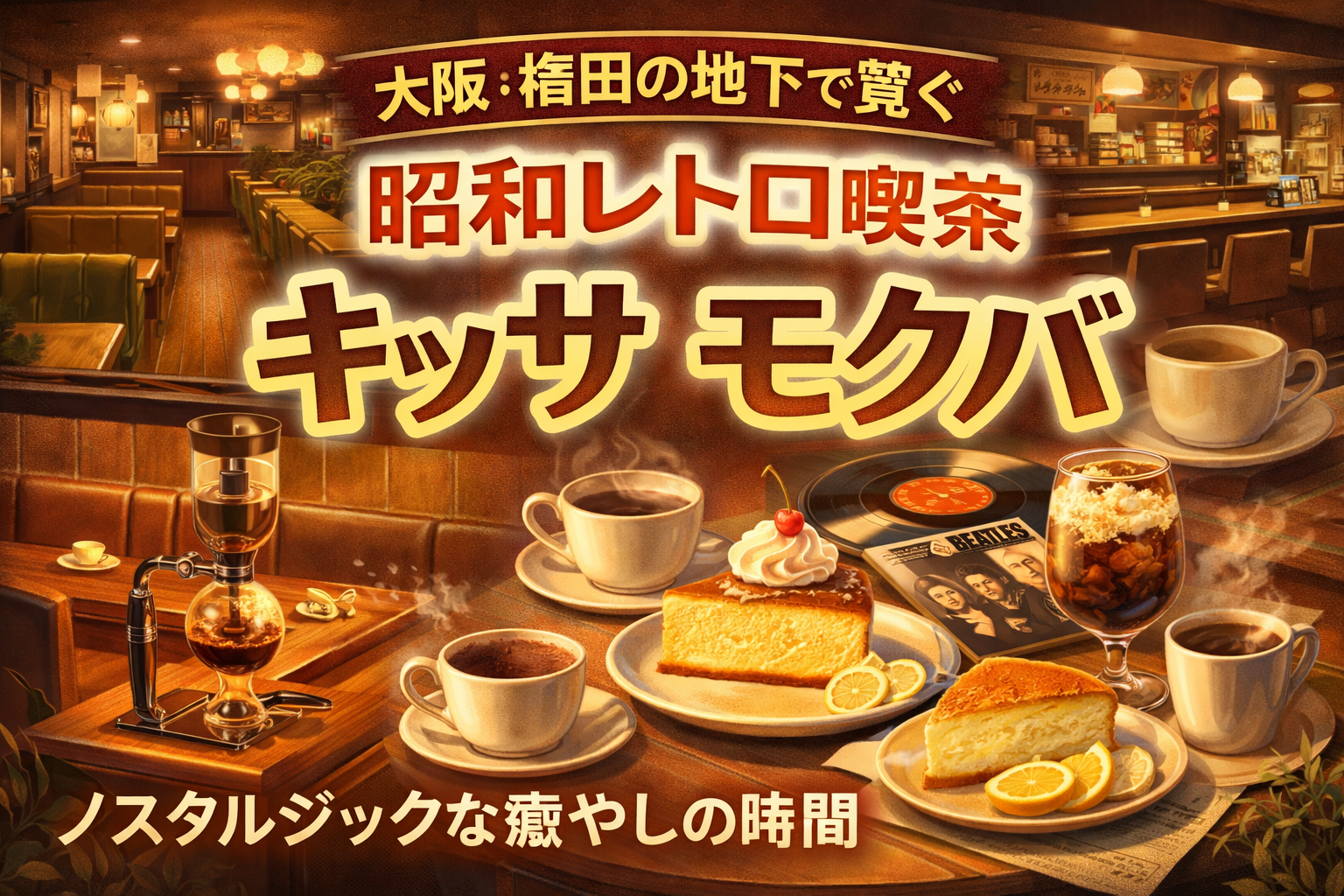
大阪という街は、にぎやかで、せわしなく、強い。巨大なターミナル駅に人があふれ、再開発が進み、飲食店も流行の移り変わりが激しい。そんな梅田のど真ん中にありながら、時間の流れが少しだけゆるみ、外の喧騒を忘れさせてくれる場所がある。それが、大阪駅前第1ビル地下2階に店を構える**「キッサ モクバ」**だ。北新地駅からすぐの場所にあり、食べログでは大阪市北区梅田1-3-1 大阪駅前第1ビルB2F、北新地駅から至近の喫茶店として案内されている。
キッサ モクバの魅力は、まず何よりも**“地下にある純喫茶らしさ”**にある。大阪駅前ビル地下街という、少し雑多で少し昭和の気配が残る空間を歩いていくと、店はビルの奥まった場所に静かに現れる。外から見ると派手ではない。むしろ、見つけにくいことさえこの店の個性になっている。だからこそ扉の向こうには、通りすがりの消費の場ではなく、「わざわざ入る価値のある場所」が残っているように感じられる。地下街の喧噪から一歩引いた位置にあり、落ち着いたレトロ喫茶として紹介されている点も、この店の印象をよく表している。
店内に入ると、現代的なカフェとは明らかに違う空気が流れている。オレンジ系の壁、木のテーブル、やや照度を落とした照明、カウンターやソファ席の落ち着いた配置。レビューや紹介記事では、アンティーク風の内装や温かみのある灯りが印象的だと語られており、白く明るい“映え”中心のカフェにはない、深い呼吸を促すような居心地がある。ここでは、過度な演出や過剰な情報がないぶん、自分の感覚が静かに戻ってくる。都会の真ん中にありながら、心の速度を落とせる店は実は少ない。キッサ モクバは、その希少な一軒だ。
この店が多くの人を引きつける理由のひとつが、純喫茶文化をしっかり残していることだ。PrettyOnlineの記事では、キッサ モクバは1980年創業と紹介されている。つまり、単にレトロ“風”なのではなく、本当に長い時間をこの街で過ごしてきた店なのだ。昭和から平成、令和へと時代が変わってもなお、店が持つ空気は大きく変わらない。そうした積み重ねが、内装やメニューの一つひとつに自然な説得力を与えている。近年は若い世代が「エモい」と感じて訪れる一方で、昔ながらの喫茶店を知る世代にとっては懐かしさそのものでもある。キッサ モクバには、世代をまたいで共有できる時間の厚みがある。
コーヒーにも、この店らしい誠実さがある。リビング大阪の記事では、注文後に豆を挽き、サイフォンでコーヒーを淹れるこだわりが紹介されている。サイフォン式の抽出は、見た目にもどこかクラシカルで、純喫茶の記憶を呼び起こす。香りが立ちのぼり、カップが置かれるまでの時間さえ、ここでは体験の一部になる。急いで飲み切るための一杯ではなく、席に腰を落ち着け、店の空気と一緒に味わう一杯。そういうコーヒーが、この店には似合う。世界各国の豆を楽しめるという紹介もあり、単に雰囲気だけでなく、喫茶店としての“中身”がきちんと支えられていることがわかる。
そしてキッサ モクバは、コーヒーだけの店でもない。スイーツの存在感も大きい。PrettyOnlineでは自家製スイーツが紹介され、リビング大阪では店内で焼くバスクチーズケーキや国産レモン使用のレモンケーキが取り上げられている。さらに訪問記では、ウィンナーコーヒーやチーズケーキ、トーストセット、サンドイッチセットなどが好評で、喫茶店らしい安心感のあるメニュー構成が見えてくる。食事を主役にする大型カフェではなく、コーヒーと甘いもの、あるいは軽食と静かな時間を楽しむための店。そこに純喫茶の本質がある。派手な盛りつけや流行の素材ではなく、長く愛される定番を丁寧に出す。その控えめな姿勢が、この店の魅力をいっそう深くしている。
また、キッサ モクバは音のある喫茶店としても印象的だ。リビング大阪の記事には、入口付近のレコードプレーヤーと、そこから流れるビートルズの音楽についての記述がある。近年のカフェではBGMが単なる背景音になりがちだが、この店では音もまた空間の一部だ。レコードという存在が、店の空気にやわらかな陰影を与えている。視覚だけでなく、聴覚でも“昔ながら”を感じられることは、この店を単なるレトロ内装の店で終わらせない。店に漂う懐かしさは、家具や照明だけでなく、音の質感まで含めて成り立っているのである。
キッサ モクバがある大阪駅前第1ビルという場所も、この店の魅力を語る上で欠かせない。梅田の再開発エリアのようなきらびやかさとは別の、大阪の古い都市文化が地下に残る場所。そのビルの奥で、キッサ モクバは今も静かに営業している。食べログでは月~木は9:00~22:00、金土日祝・祝前日は9:00~23:00と案内されており、朝のモーニング利用から夜の喫茶時間まで幅広く使いやすい。モーニングについては、別記事で9:00~11:00の提供やトーストセット、サンドイッチセットなども紹介されている。なお、営業時間や提供内容は変更の可能性があるため、訪問前に最新情報を確認するのが安心だ。
この店の良さは、結局のところ**“目的地になれる喫茶店”**であることに尽きるかもしれない。梅田で少し休む場所なら、今や無数にある。それでも人がキッサ モクバを選ぶのは、単に座れるからではない。そこに、この店でしか味わえない時間があるからだ。地下街の少し暗い通路を抜け、あの灯りの下に身を置き、コーヒーの香りとレコードの音を受け取る。その一連の流れが、すでに小さな体験になっている。便利さだけならチェーン店で足りる。けれど、記憶に残る休憩は、こういう場所でしか得られない。
大阪はしばしば、派手でエネルギッシュな街として語られる。しかし本当の魅力は、こうした“静かな名店”の存在にもあるのではないだろうか。キッサ モクバは、目立ちすぎず、流行に迎合しすぎず、それでも確かに人を惹きつける。昭和から続く純喫茶文化のやわらかな余韻を、令和の梅田で今も味わえる場所。大阪の街歩きの途中に立ち寄るのはもちろん、むしろこの店に行くために地下街へ向かいたくなる。キッサ モクバは、そんな力を持った一軒である。
Kissa Mokuba: A Quiet Refuge of Nostalgia Hidden Beneath Osaka
Osaka is often seen as a city of energy, noise, and constant movement. Its major stations are crowded, redevelopment continues at a rapid pace, and restaurants rise and fall with changing trends. Yet in the very heart of Umeda, there is a place where time seems to slow down just a little, allowing visitors to forget the bustle outside. That place is Kissa Mokuba, a coffee shop located on the basement second floor of Osaka Ekimae Daiichi Building. Tucked away near Kitashinchi Station, it is the kind of café that offers not simply coffee, but a certain atmosphere that feels increasingly rare in the modern city.
One of the first things that makes Kissa Mokuba special is its strong sense of being a true underground kissa, or traditional Japanese coffee shop. As you walk through the basement arcade of the Osaka station-area buildings, with its slightly chaotic and unmistakably Showa-era feel, the shop appears quietly in a corner of the complex. It is not flashy, and in fact, it can even be a little difficult to find. But that hidden quality is part of its charm. Rather than existing as a place for casual, thoughtless consumption, it feels like somewhere worth intentionally seeking out. The moment you step inside, it becomes clear that this is not simply another café competing for attention, but a place that has preserved a more personal and enduring kind of value.
The interior carries an atmosphere that is clearly different from that of modern cafés. Warm-toned walls, wooden tables, softly dim lighting, and the relaxed arrangement of counter seats and sofas all create a sense of calm. It is often described as having an antique-like interior and a comforting glow. Unlike the bright, minimalist spaces of many contemporary cafés designed mainly for social media appeal, Kissa Mokuba invites deeper breathing and quieter thought. Because there is no excess of visual stimulation or overdesigned presentation, one’s senses seem to settle naturally. In the middle of one of Japan’s busiest urban districts, it offers something rare: a place where the speed of the mind can slow down.
Another reason so many people are drawn to Kissa Mokuba is that it genuinely preserves the culture of the jun-kissa, or classic Japanese coffeehouse. The shop is said to have opened in 1980, which means it is not merely retro in style. It is a place that has truly lived through decades of Osaka’s history. From the Showa period to Heisei and now Reiwa, the essential atmosphere of the shop has remained intact. That passage of time gives a natural authenticity to everything inside, from the décor to the menu. In recent years, younger visitors have been attracted to the café for its nostalgic and “emotional” appeal, while older generations may find in it the very real comfort of remembered places. Kissa Mokuba holds a depth of time that can be shared across generations.
Its coffee reflects the same sincerity. One of the shop’s notable features is that the beans are ground only after an order is placed, and the coffee is brewed using a siphon. The siphon method itself has an unmistakably classic charm, evoking memories of old-fashioned coffeehouses. Watching the preparation, smelling the aroma as it rises, and waiting for the cup to arrive all become part of the experience. This is not coffee meant to be rushed through on the way to the next errand. It is coffee meant to be enjoyed while sitting still, immersed in the room itself. The shop is also said to offer beans from various countries, suggesting that its appeal lies not only in its atmosphere, but in the quality and seriousness of the coffee as well.
At the same time, Kissa Mokuba is not a place that lives on coffee alone. Its sweets and light meals are another important part of its identity. The café is known for its homemade desserts, including Basque cheesecake baked in-house and lemon cake made with domestically grown lemons. Visitors also praise items such as Viennese coffee, cheesecake, toast sets, and sandwich sets. This menu reflects the comforting reliability one hopes to find in a traditional coffee shop. It is not a large café trying to overwhelm guests with trendy dishes or elaborate presentations. Rather, it is a place designed for enjoying coffee with something sweet, or a light meal accompanied by a peaceful pause in the day. That restraint is part of what makes it so appealing. Instead of chasing novelty, it offers classics with care.
Kissa Mokuba is also memorable as a café with a distinct sense of sound. Near the entrance, there is said to be a record player, and music by The Beatles sometimes fills the room. In many modern cafés, background music is little more than a sonic accessory. Here, however, sound feels like an essential part of the space. The presence of records adds another layer of warmth and texture to the atmosphere. The nostalgia of the café is not created only through furniture and lighting, but also through the quality of the sound itself. This attention to mood helps prevent the shop from becoming merely a retro-themed place. Its atmosphere feels lived-in rather than staged.
The location of Kissa Mokuba within Osaka Ekimae Daiichi Building is also central to its appeal. The building belongs to a part of Osaka that preserves an older urban culture beneath the glossier surfaces of redevelopment. While the newer parts of Umeda shine with polished modernity, the underground areas of the station buildings still hold traces of an earlier Osaka. In that setting, Kissa Mokuba continues to operate quietly, almost like a guardian of a slower and softer urban rhythm. It is a place that fits naturally into its surroundings.
Perhaps the greatest strength of Kissa Mokuba is that it is the kind of café that can become a destination in itself. In Umeda, there is no shortage of places to sit down for a break. Yet people choose Kissa Mokuba not simply because it offers a seat, but because it offers a kind of time that cannot be found elsewhere. Walking through the dim basement passages, stepping into the gentle light of the café, breathing in the aroma of coffee, and listening to music from another era—this whole sequence forms a small but meaningful experience. Convenience alone can be found in any chain café. But memorable rest, the kind that lingers in the mind, belongs to places like this.
Osaka is often described as flashy, loud, and full of momentum. But perhaps part of its true charm lies in quiet places like Kissa Mokuba. It does not try too hard to stand out, nor does it chase trends. And yet it continues to attract people. It is a place where the soft afterglow of traditional Japanese coffeehouse culture can still be felt in contemporary Umeda. One can stop by during a walk around the city, of course, but it may be even more fitting to head into the underground streets for the sake of the café itself. Kissa Mokuba is that kind of place: a hidden classic with the power to become the reason for the journey.

コメント