
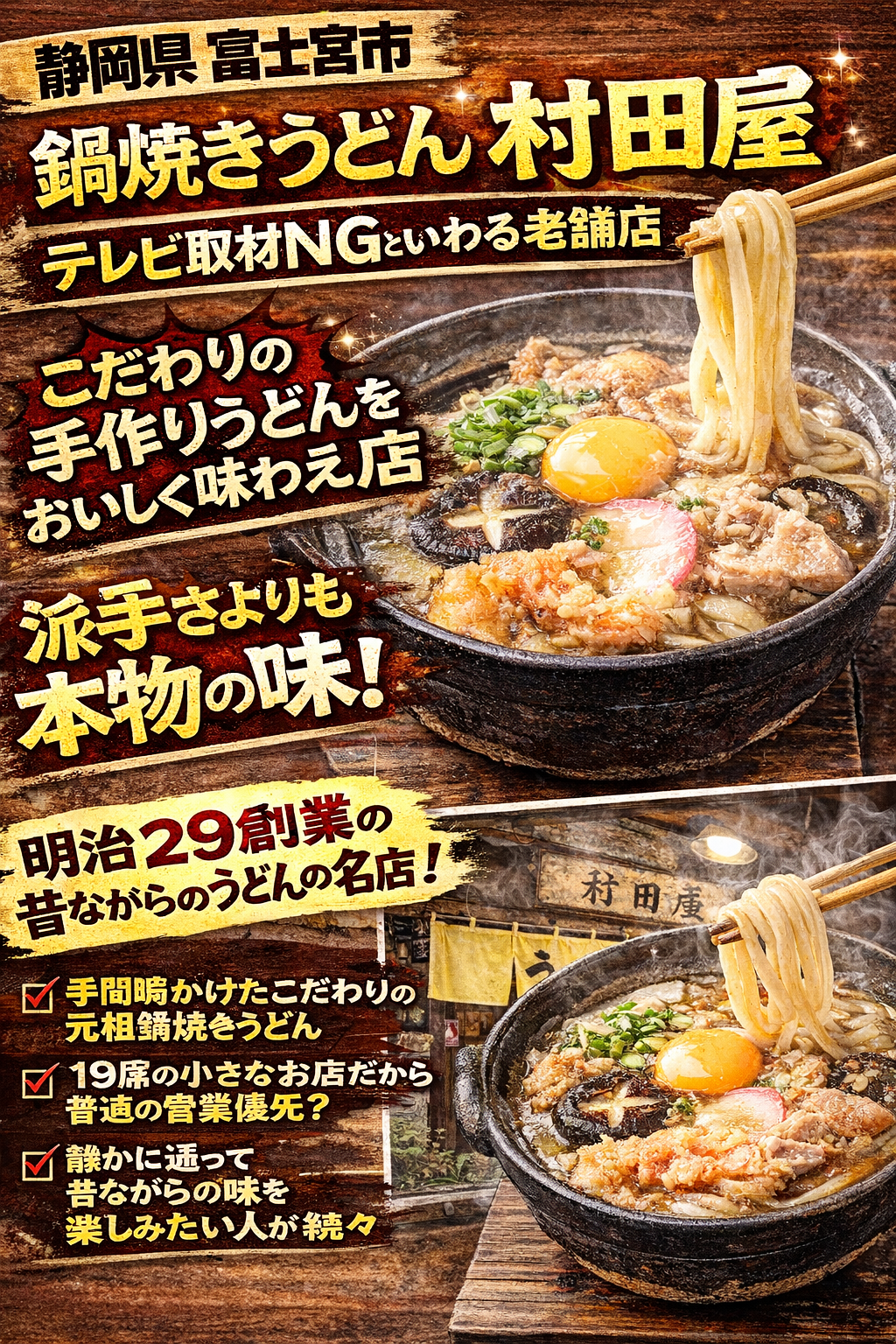
- まず結論:公開情報では「テレビ撮影NG」の明記は確認できない
- 村田屋は、明治29年創業の“元祖鍋焼きうどん”の老舗
- 村田屋が特別なのは、“手間のかかり方”が見えること
- 「テレビ撮影NG」と言われやすいのは、店のサイズと空気感のせいかもしれない
- そもそも村田屋は、“テレビ映え”より“地元の定番”として強い
- 村田屋が支持されるのは、“昔ながら”を雑にしていないから
- 初めて行くなら、やはり元祖鍋焼きうどんから
- まとめ|「テレビ撮影NG」と言われても、結局気になるのは味が本物だから
- First, the key point: there is no publicly confirmed statement saying “TV filming is prohibited”
- Murataya is a long-established shop known as the original nabeyaki udon restaurant in Fujinomiya
- What makes Murataya special is how clearly you can see the labor behind the food
- The “no TV filming” image may come from the shop’s size and atmosphere more than from any stated rule
- Murataya feels stronger as a “local standard” than as a made-for-TV destination
- What people seem to love is that Murataya has preserved “old-fashioned” quality without becoming careless
- If you go for the first time, the original nabeyaki udon should come first
- Final thoughts: whatever the filming question may be, people stay interested because the food feels real
まず結論:公開情報では「テレビ撮影NG」の明記は確認できない
富士宮市の村田屋について検索すると、ときどき見かけるのが「テレビ撮影NG」という言い方です。結論から言うと、今回確認できた公開情報の範囲では、村田屋が公式に“テレビ撮影NG”を明記している事実は確認できませんでした。一方で、食べログの店舗情報や地域メディアの記事、店の紹介文を見ていくと、なぜそういうイメージを持たれやすいのかはかなり想像しやすい店でもあります。
つまりこの記事では、「本当に撮影NGなのか」を断定するのではなく、なぜそう言われやすいのか、そしてそれでも人が通いたくなる理由は何なのかを、店の実像に沿って整理していきます。
村田屋は、明治29年創業の“元祖鍋焼きうどん”の老舗
村田屋は静岡県富士宮市西町10-13にあるうどん店で、食べログ上でも**「明治二十九年創業。富士宮市の鍋焼きうどんの老舗」と紹介されています。最寄りは西富士宮駅から約306メートルで、営業は11:00〜14:00、16:30〜20:00**、木曜定休。席数は19席、予約不可、駐車場は12台とされています。
地域メディアでも、村田屋は創業明治29年の老舗として紹介されていて、店の看板商品はもちろん元祖鍋焼きうどんです。フジみるの記事では、並・上・特上の3種類があり、たとえば取材時点で並750円、上1,000円、特上1,100円と案内されています。さらに名物カツ丼やきしざるも人気だと紹介されていて、鍋焼きうどん一本に絞った極端な専門店というより、昔ながらの食事処として地元に根付いてきた店だと分かります。
村田屋が特別なのは、“手間のかかり方”が見えること
村田屋の魅力は、単に老舗という肩書きだけではありません。食べログの店舗PRには、出汁について宗田かつお・イワシ・かつおを合わせていること、麺については数種の小麦粉を独自配合し、塩を加えた水で仕込み、一晩寝かせ、翌日に何度も伸ばして平打ち麺にしていることが書かれています。さらに、天ぷらはイカをさいの目にカットして揚げる村田屋オリジナルの手作りかき揚げとされていて、仕込みに手数がかかっていることが伝わってきます。
この“手間のかかり方”は、実際のメニュー構成にも表れています。フジみるの記事では、鍋焼きうどんだけでも並・上・特上・御飯付き鍋焼きうどん・おじやうどん・おぞうにうどんなどがあり、ご飯物も名物カツ丼、親子丼、肉丼、天丼までそろっています。昔ながらの個人店でこれだけの品数を回している時点で、日々の営業はかなり濃いはずです。
「テレビ撮影NG」と言われやすいのは、店のサイズと空気感のせいかもしれない
公開情報で“テレビ撮影NG”の断定材料は見つかっていませんが、そう言われやすい理由はいくつか考えられます。まずひとつは、店が大きくないことです。食べログでは19席、フジみるでも店内は2人掛けテーブル4つ、4人掛けテーブル2つで16名ほどと紹介されており、決して大箱ではありません。予約不可で、昼営業も夜営業も比較的コンパクトです。
この規模の店だと、テレビカメラや照明、スタッフの出入りがあるだけで、ふだんの営業のリズムが崩れやすくなります。しかも村田屋は、鍋焼きうどんのように熱々で提供タイミングが重要な料理を主力にしています。これは私の推測ですが、もし取材を積極的に受けないとしても、それは“秘密主義”というより、普通の営業と料理の質を優先しているからと考えるほうが自然です。食べログの情報からも、予約不可・小規模・手仕込み中心という営業スタイルが見えており、派手な露出より日々の流れを守る店であっても不思議ではありません。
そもそも村田屋は、“テレビ映え”より“地元の定番”として強い
村田屋の魅力は、今どきの“映え店”の文脈とは少し違います。フジみるの記事では、地元の常連客に持ち帰りが喜ばれていることや、県外からの観光客も元祖鍋焼きうどんを求めて訪れる人気店だと紹介されています。つまり村田屋は、SNSやテレビで急に話題になるタイプというより、昔から知っている人が普通に通い続けてきた店です。
しかも、主役の鍋焼きうどんはかなり分かりやすくおいしそうです。フジみるでは、出来立てほやほやで熱々、元祖鍋焼きうどんの上はイカ天と玉子、特上は海老天と玉子とあり、食べログの口コミでも、独特の平打ち麺や醤油ベースのうまみあるつゆ、干し椎茸の香り、そして最後にご飯を入れて雑炊風に楽しむ食べ方まで語られています。村田屋は、派手な演出がなくても十分印象に残る料理を持っている店です。
村田屋が支持されるのは、“昔ながら”を雑にしていないから
老舗という言葉は便利ですが、ただ長く続いているだけではここまで支持されません。村田屋が今も気になる店であり続けるのは、昔ながらの店構えや料理を、惰性ではなく手間をかけて維持しているからだと思います。食べログのPRでも、出汁・麺・天ぷらそれぞれに手間の説明があり、観光の際にはぜひ立ち寄ってほしいと案内しています。これは逆に言えば、派手な宣伝に頼らなくても来てくれる人がいる店だということでもあります。
だからこそ、「テレビ撮影NG」という言葉が本当かどうか以上に、村田屋には**“取材に振り回されない店っぽさ”があるのかもしれません。小さな店で、熱い鍋焼きうどんを丁寧に出し、昔からのやり方を守る。その姿勢自体が、今の時代にはむしろ魅力になっています。これは公開情報からの印象のまとめですが、村田屋はメディア向けに作られた店ではなく、結果として人が集まる店**に見えます。
初めて行くなら、やはり元祖鍋焼きうどんから
初訪問なら、やはり中心は元祖鍋焼きうどんです。フジみるでは、上が1,000円、特上が1,100円とされ、上にはイカ天・玉子・椎茸・鶏肉、特上には海老天・玉子・椎茸・鶏肉が入ると紹介されています。鍋焼きうどんの店として看板が明確なので、まずここから入るのが自然です。
一方で、もし余裕があれば名物カツ丼もかなり気になります。フジみるでは1,100円で、玉子と玉ねぎの甘みがしみたジューシーなカツと紹介されています。食べログでもジャンルにかつ丼が並んでいるので、村田屋は“鍋焼きうどんだけの一発屋”ではありません。むしろ、うどんも丼も昔ながらに強い食堂という見方のほうが近そうです。
まとめ|「テレビ撮影NG」と言われても、結局気になるのは味が本物だから
村田屋については、今回確認した公開情報では公式な「テレビ撮影NG」表記は見つかりませんでした。ただし、明治29年創業の老舗で、19席の小さめの店、予約不可、手仕込み中心の鍋焼きうどんという条件を見ると、テレビ取材より日常営業を優先していそうだ、と受け取る人がいても不思議ではありません。
そして何より大事なのは、そんな“撮影どうこう”を抜きにしても、村田屋が十分に魅力的だということです。独自配合で一晩寝かせる平打ち麺、宗田かつお・イワシ・かつおの出汁、村田屋オリジナルのイカ天、そして熱々で最後まで楽しめる元祖鍋焼きうどん。こうした積み重ねがあるから、村田屋は今も富士宮で気になる店であり続けています。
Murataya’s Nabeyaki Udon: Why People Say “No TV Filming” — and Why the Shop’s Quiet, Old-School Atmosphere Matters More Than Media Exposure
First, the key point: there is no publicly confirmed statement saying “TV filming is prohibited”
When people search for Murataya in Fujinomiya, one phrase that sometimes comes up is “no TV filming.” Based on the publicly available sources I checked, I could not confirm any official statement from the shop explicitly saying that television filming is prohibited. What the public information does show, however, is a restaurant with a very specific style: small, long-established, labor-intensive, and deeply rooted in everyday local dining. That makes it easy to understand why some people may have formed that impression.
So rather than claiming that Murataya is definitively “TV-filming NG,” it is more accurate to ask a different question: why does the place feel like the kind of shop that might avoid media disruption in the first place?
Murataya is a long-established shop known as the original nabeyaki udon restaurant in Fujinomiya
Murataya is located at 10-13 Nishimachi, Fujinomiya, Shizuoka, and both its own website and restaurant listings present it as a historic destination for nabeyaki udon. Tabelog describes it as a long-established Fujinomiya nabeyaki udon shop founded in 1896, while the shop’s own site also frames it as the place to stop by when visiting Fujinomiya, Mount Fuji, or Sengen Taisha.
Public listings place it about 306 meters from Nishi-Fujinomiya Station, with business hours generally shown as 11:00 a.m. to 2:00 p.m. and 4:30 p.m. to 8:00 p.m., though a recent local feature gives the evening window as 4:30 p.m. to 8:30 p.m. with last order at 8:00 p.m. That same local article lists Thursdays and the second Wednesday of the month as regular closing days, while Tabelog shows Thursday. In practice, that means visitors should check the latest information before going.
The restaurant is also small. Tabelog lists 19 seats, while the local feature describes a modest layout of two-person and four-person tables totaling around 16 seats. It is also listed as reservation unavailable and has parking for 12 cars.
What makes Murataya special is how clearly you can see the labor behind the food
Murataya’s appeal is not just that it is old. It is that the public descriptions make the work behind the food very visible.
On Tabelog, the shop explains that its broth combines sodagatsuo, sardine, and bonito, while the noodles are made from a proprietary blend of several flours, prepared with salted water, rested overnight, and then stretched repeatedly the next day into flat noodles. The tempura is also described as a Murataya original, especially its handmade squid kakiage, made by cutting squid into small cubes before frying.
That kind of process matters. It means this is not a restaurant coasting on the aura of being “old-fashioned.” It is a place still investing serious effort in broth, noodles, and toppings.
The menu reflects that same depth. A recent local article says the restaurant offers regular, upper, and premium nabeyaki udon, along with variations like rice-set nabeyaki udon, ojiya udon, and ozoni udon, plus rice bowls such as its famous katsudon, oyakodon, nikudon, and tendon. For a relatively small, family-style shop, that is a lot to manage in daily service.
The “no TV filming” image may come from the shop’s size and atmosphere more than from any stated rule
Again, I could not confirm a public statement explicitly banning television filming. But it is not hard to see why people might assume the shop would be reluctant about that kind of attention.
The first reason is scale. A restaurant with around 16 to 19 seats, no reservations, and a service model built around hot, timing-sensitive dishes is naturally more vulnerable to disruption. Even a small filming crew can change the rhythm of a place like that.
And nabeyaki udon is exactly the kind of dish where timing matters. It needs to arrive piping hot, and the experience is tied to that. This is my inference rather than a confirmed shop policy, but if Murataya is cautious about media exposure, it would make more sense to read that as a commitment to protecting normal service and food quality, not as secrecy for its own sake. The public information points to a compact, hand-crafted, old-school operation. A shop like that may simply value smooth daily business more than television visibility.
Murataya feels stronger as a “local standard” than as a made-for-TV destination
Another reason this restaurant inspires that kind of image is that its appeal does not depend on spectacle.
The recent local feature says Murataya is appreciated not only by tourists looking for the original nabeyaki udon, but also by local regulars, including people who value its takeout offerings. That tells you a lot. This is not the kind of place that needed social media virality or national TV attention to build its name. It is a place that has been part of daily life for a long time.
And the food sounds compelling enough without any dramatic presentation. The same local feature describes the upper-grade nabeyaki udon as coming with squid tempura and egg, while the premium version includes shrimp tempura and egg. Reviews on Tabelog also mention the restaurant’s flat noodles, soy-based broth, dried shiitake aroma, and even the way some customers finish the meal by adding rice to the remaining broth like a light porridge. In other words, Murataya does not need a flashy media setup to leave an impression. The dish itself already does that.
What people seem to love is that Murataya has preserved “old-fashioned” quality without becoming careless
Plenty of restaurants are old. Far fewer stay meaningful.
What makes Murataya feel worth talking about is that its old-fashioned style appears to be supported by real technique and consistency. Tabelog’s shop description goes out of its way to explain the work behind the broth, noodles, and tempura, and the official site presents the restaurant as a destination worth visiting when in Fujinomiya. That suggests a shop with confidence in its craft, not one depending on aggressive promotion.
That is why the phrase “no TV filming” may ultimately say less about literal rules and more about the atmosphere people sense there. Murataya feels like the kind of restaurant that does not bend itself around media. It feels like a place that serves hot food carefully, in a modest room, according to its own rhythm. In the current era, that kind of steadiness can be more attractive than publicity.
If you go for the first time, the original nabeyaki udon should come first
For a first visit, the obvious place to start is the restaurant’s signature original nabeyaki udon.
The recent local feature says the shop offers regular, upper, and premium versions, and gives example prices of 750 yen, 1,000 yen, and 1,100 yen at the time of reporting. It also notes that the upper version includes squid tempura, egg, shiitake, and chicken, while the premium version swaps in shrimp tempura. That kind of structure makes the restaurant’s specialty easy to understand.
At the same time, the shop is not only about udon. The same article also highlights the restaurant’s famous katsudon, listed there at 1,100 yen, and describes it as juicy pork cutlet matched with sweet onion and egg. Tabelog also categorizes the place not only under udon but also katsudon. So Murataya seems better understood not as a one-dish specialty place, but as a classic local eatery that happens to be especially known for nabeyaki udon.
Final thoughts: whatever the filming question may be, people stay interested because the food feels real
Based on the public sources I checked, I could not verify any official statement that Murataya is explicitly “TV filming NG.” But when you look at the available facts — a shop founded in 1896, a small dining room, no reservations, hand-prepared broth and noodles, and a flagship dish that depends on heat and timing — it becomes easy to see why people might think of it as a place that prioritizes ordinary service over media attention.
And in the end, that may not even be the most important point. What really makes Murataya interesting is that it sounds deeply appealing regardless of cameras: flat noodles rested overnight, broth built from multiple fish stocks, Murataya’s original squid tempura, and steaming-hot nabeyaki udon that invites you to savor every last drop. That is the kind of restaurant that keeps people curious even without television.

コメント