

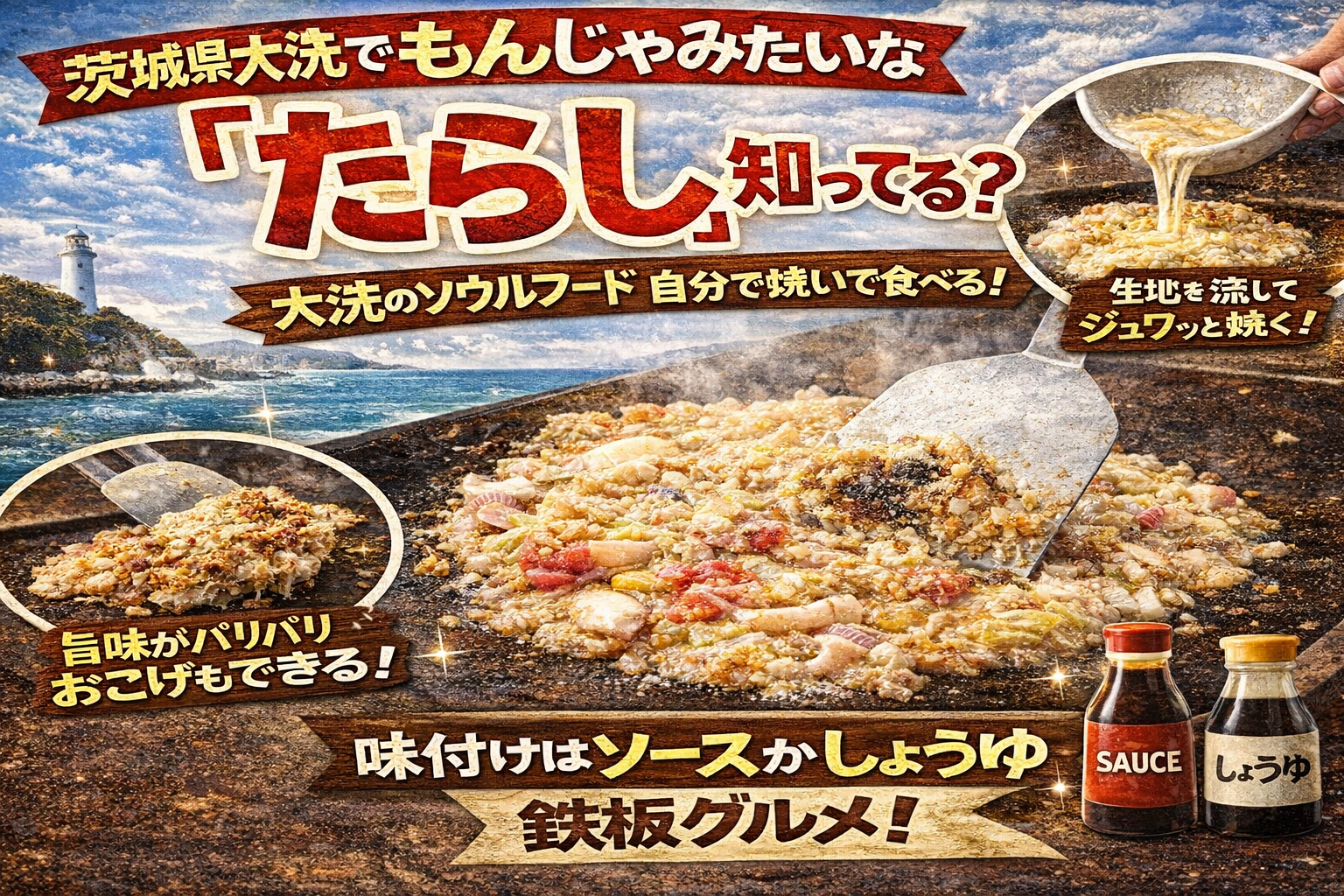
茨城県大洗で「もんじゃみたいなやつ、あれ何?」と聞かれたら、答えはだいたい**「たらし」です。大洗では昔から親しまれてきたローカルフードで、見た目はもんじゃ焼きに少し似ていますが、食べてみるとちゃんと別物。大洗観光協会も、町内の店を紹介する中で「大洗のローカルフード『たらし』」**と明記していて、いまも観光客が探しに来るご当地グルメとして扱っています。
- まず結論:「たらし」は“もんじゃ風”だけど、大洗ではちゃんと独立した食文化
- どうして大洗で愛されてきたのか
- たらしは何がうまいのか――派手じゃないのに、妙にクセになる
- 食べ方も楽しい:自分で焼く時間まで含めて“たらし”
- 大洗で食べるならどこ?
- 観光グルメとしての“たらし”の強さ
- まとめ
- What’s that “monjayaki-like thing” in Oarai?
- Why people in Oarai love it
- What does it taste like?
- Part of the fun is cooking it yourself
- Where can you try it in Oarai?
- Why tarashi is worth writing about
- Final takeaway
まず結論:「たらし」は“もんじゃ風”だけど、大洗ではちゃんと独立した食文化
たらしは、小麦粉をだしでゆるく溶いた生地に、キャベツ、ネギ、卵、紅しょうが、切りイカなどを入れて、鉄板で焼きながら食べる料理です。味付けはソースかしょうゆが基本で、店や好みで選ぶスタイルが多いと紹介されています。見た目はたしかにもんじゃに近いのですが、もんじゃのように「土手」を作らないのが大きな違いです。
つまり、大洗の人にとって「たらし」は、もんじゃの仲間というより、“大洗のたらし”という一つの完成した食べ物。外から来た人が「もんじゃみたい」と表現するのは自然ですが、地元目線では“似てるけど違う”がしっくりきます。
どうして大洗で愛されてきたのか
たらしは、大正時代ごろから大洗で食べられてきたと言われ、主に駄菓子屋で売られるおやつとして親しまれてきたそうです。学校帰りや休日に子どもたちが食べる、いわば“町の思い出の味”。茨城の郷土食を紹介するサイトでも、昭和のころには大洗にたらしを出す店が何十軒もあったが、現在は提供する店が少なくなっている、といった文脈で語られています。
ここが面白いところで、海の町・大洗というと海鮮やあんこうを思い浮かべがちですが、地元の人の生活に深く根付いてきた味としては、こういう素朴な粉もの文化もちゃんと残っているんです。高級グルメではなく、日常の中のあたたかい食べ物。だからこそ“ソウルフード”と呼ばれる説得力があります。
たらしは何がうまいのか――派手じゃないのに、妙にクセになる
たらしの魅力は、豪華さではなく鉄板の香ばしさにあります。ゆるめの生地を少しずつ鉄板にたらし、ヘラで押しつけながら焼いていくと、表面に香ばしい焦げ目がつき、場所によってはパリパリのおこげもできる。この“やわらかい部分”と“せんべいみたいに香ばしい部分”の両方を楽しめるのが特徴です。
しかも、たらしは卵が入ることも多く、食感としてはもんじゃより少しまとまりやすいと紹介されることがあります。実際に大洗の提供店を訪ねた体験記事でも、「もんじゃ焼きともお好み焼きとも少し違う」「ふんわり感もある」といった感想が書かれていて、“もんじゃとお好み焼きの中間”みたいな感覚を持つ人も多そうです。
要するに、たらしは「見た目でもんじゃを想像して食べると、ちょっと意外」「でも食べ終わるころには、これはこれでアリどころか、かなり好き」となりやすいタイプ。派手ではないけれど、あとからじわじわ思い出す味です。
食べ方も楽しい:自分で焼く時間まで含めて“たらし”
たらしは、完成品が出てくるというより、鉄板の上で自分で焼きながら食べる楽しさも大きい料理です。店によって作法は少し違いますが、基本は生地を流して、ヘラで押さえたり、少しずつはがしたりしながら食べるスタイル。もんじゃほど技術はいらず、でも「ただ待つだけ」でもない。この絶妙な参加感がいいんですよね。
ソース派かしょうゆ派かで印象が変わるのも、たらしの面白いところ。濃いめにしたい人はソース、素朴さを味わいたい人はしょうゆ、というふうに楽しみ方が分かれます。トッピングもできる店があり、ベビースターやチーズなどを足して“今っぽく”食べる人もいます。
大洗で食べるならどこ?
大洗観光協会の公式サイトで確認できる店のひとつが、「お好み焼 はなわ」です。ここは観光協会が「大洗のローカルフード『たらし』が味わえるお好み焼き屋さん」と紹介していて、メニュー欄にも「大洗名物たらし ノーマル」が掲載されています。所在地は大洗町大貫町256-474、駐車場あり、営業時間は平日17時〜22時、土日祝16時〜22時(ラストオーダー20時)、定休日は月曜・火曜です。
また、体験記事などでは**「お好み焼き 道」**も、たらしを食べられる代表的な店としてしばしば紹介されています。こちらは大洗駅から徒歩圏で、観光の流れでも立ち寄りやすいとされています。
観光グルメとしての“たらし”の強さ
大洗観光というと海鮮丼、浜焼き、あんこう鍋などが目立ちます。でも、旅先で本当に記憶に残るのは、こういう**「地元の人が昔から普通に食べてきたもの」**だったりします。たらしはまさにその代表で、見た目は地味でも、土地の空気がすごく出る料理です。
海が見える町で、鉄板を前にして、ヘラで少しずつ焼いて食べる。高級感はないけれど、旅の思い出としてはかなり強い。大洗で「何かちょっと変わったものを食べたい」「海鮮以外のご当地感も欲しい」という人には、たらしはかなりおすすめです。
まとめ
茨城県大洗にある“もんじゃみたいなの”の正体は、**大洗のソウルフード「たらし」**です。小麦粉をだしで溶いた生地を鉄板で焼いて食べる素朴な料理で、土手を作らないことや、ソース・しょうゆで味を調整すること、パリパリのおこげを楽しめることが特徴。大正時代から駄菓子屋のおやつとして親しまれてきたと言われ、今も大洗のローカルフードとして受け継がれています。
大洗で「もんじゃっぽいけど違うやつ」を探しているなら、答えはかなり高い確率でたらし。そして一度食べると、「ああ、これは“もんじゃみたいなもの”じゃなくて、ちゃんと“たらし”だな」と分かるはずです。
What’s that “monjayaki-like thing” in Oarai?
The answer is Tarashi, Oarai’s local soul food (English version)
If you go to Oarai in Ibaraki Prefecture and ask, “What’s that thing that looks kind of like monjayaki?”, the answer is usually tarashi. Oarai’s official tourism site introduces it as a local Oarai food, and describes restaurants where you can try it alongside okonomiyaki and teppanyaki dishes.
At first glance, tarashi does look similar to monjayaki. But once you actually eat it, it feels like its own thing. It is not just “Oarai-style monja.” In Oarai, tarashi is treated as a distinct local food with its own history, texture, and way of eating.
Tarashi is usually made from a thin batter of flour and dashi, with ingredients such as cabbage, squid, egg, pickled ginger, and green onion. It is cooked on a hot iron plate and seasoned with either sauce or soy sauce, depending on taste. One of the clearest differences from monjayaki is that you do not make the “dote” ring that is typical of monja.
That difference sounds small, but it changes the whole feeling of the dish. Monja often feels loose and intentionally messy. Tarashi feels a little more direct and a little more old-fashioned. It is still soft and spreadable, but as it cooks, it becomes easier to scrape up and eat, and parts of it turn into delicious crispy bits on the iron plate.
Why people in Oarai love it
Tarashi is often described as Oarai’s soul food, and that is not just a travel-writing cliché. Sources describing the dish say it dates back to around the Taisho era, and that it was traditionally sold at dagashiya—small neighborhood candy and snack shops—where local children would eat it after school or on holidays.
That background explains a lot. Tarashi was never meant to be fancy. It is a simple, everyday iron-plate snack that belongs to town life. When people talk about it with affection, they are often talking about memory as much as taste: the smell of the iron plate, the little spatula in your hand, and the fun of cooking it yourself.
Today, Oarai is often associated with seafood, monkfish, and ocean views. But tarashi represents a different side of the town: not the dramatic “travel gourmet” side, but the warm local side. That is exactly why it stands out. It feels like something people actually grew up eating, not something invented for tourists.
What does it taste like?
Tarashi is not flashy, but it is the kind of food that becomes more appealing as you eat it. The batter is soft at first, but when you spread it on the hot plate and press it down with the small spatula, you get a mix of textures: tender in some spots, browned and fragrant in others. Sources describing tarashi specifically mention the pleasure of the crispy, cracker-like scorched bits that form on the iron plate.
That texture is one of the biggest reasons people remember it. It gives tarashi a charm that is different from both monjayaki and okonomiyaki. One travel report about trying tarashi in Oarai describes it as feeling somewhere between the two: more cohesive than monja, but lighter and looser than okonomiyaki.
Because egg is often included, tarashi can feel a little softer and rounder in flavor than monja. Sauce gives it more punch and familiarity, while soy sauce keeps it simpler and more old-school. That freedom is part of the fun. The same basic dish can lean savory, smoky, nostalgic, or snack-like depending on how you season it.
Part of the fun is cooking it yourself
Another reason tarashi leaves such a strong impression is that eating it is a little interactive. In many places, it is served in a bowl or mixture that you cook yourself on the iron plate. You pour some of it down, spread it, press it, scrape it up, and keep going. It is not as technique-heavy as monjayaki can sometimes feel, but it is also not just a finished dish being dropped in front of you.
That balance makes tarashi easy for visitors. You get the pleasure of “doing it yourself” without feeling like you need special skill. One recent travel account says the staff can explain how to cook it, and that toppings such as Baby Star ramen can be added for extra crunch.
This hands-on style is important to tarashi’s identity. It is not just the flavor that matters. The act of cooking, scraping, waiting for the edges to crisp, and deciding whether you want sauce or soy sauce is part of what makes it memorable.
Where can you try it in Oarai?
One officially recognized place is Okonomiyaki Hanawa. Oarai’s official tourism site specifically describes it as an okonomiyaki restaurant where you can enjoy Oarai’s local food, tarashi.
Another frequently mentioned place is Okonomiyaki Michi, which appears in travel writeups as one of the representative spots for tarashi in Oarai. A recent report says it is about a 7-minute walk from Oarai Station, with parking beside the shop, and describes tarashi there as self-cooked on the iron plate.
One more place that appears in listings is Tarashiyaki Takeda, which shows that tarashi still survives at several specialist or semi-specialist spots even though it is far less common than it used to be.
That last point matters. Sources note that tarashi used to be available in many more places in Oarai, but the number of shops serving it has dropped sharply over time. That makes it even more worth trying when you visit.
Why tarashi is worth writing about
A lot of regional food articles focus on obvious showpieces: luxury seafood, giant bowls, photogenic desserts. Tarashi is different. It is humble. But that is exactly why it is so good as a travel story.
It tells you something real about Oarai. Not just what visitors eat, but what local people used to eat casually. It carries the feeling of neighborhood snack culture, iron plates, small shops, and after-school food. That kind of dish often says more about a town than its most expensive restaurant does.
And for travelers, tarashi is memorable because it creates a small moment. You sit down in a seaside town, face an iron plate, and cook a local dish with a spatula while the batter browns in front of you. It is simple, but it feels very rooted in place.
Final takeaway
The “monjayaki-like thing” in Oarai, Ibaraki is tarashi, a long-loved local food made from loose flour-and-dashi batter with ingredients like cabbage, squid, egg, pickled ginger, and green onion. It is cooked on an iron plate, flavored with sauce or soy sauce, and unlike monja, it does not use a dote ring. It has been described as a local snack going back to around the Taisho era, and as one of Oarai’s true soul foods.
So if someone asks, “What’s that monja-looking thing in Oarai?”, the best answer is:
It’s tarashi — and once you eat it, you stop thinking of it as ‘something like monjayaki’ and start thinking of it as its own food.

コメント