
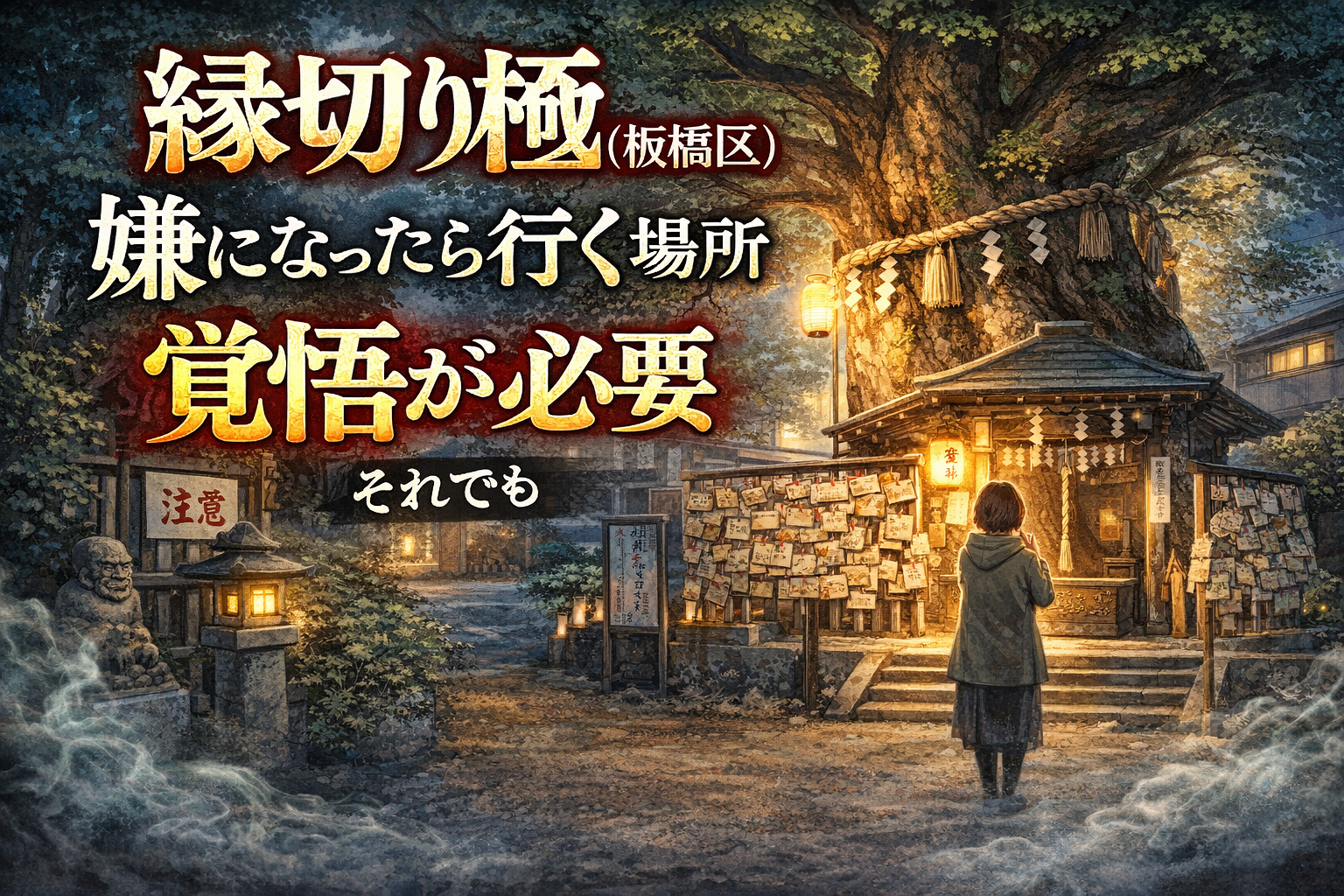
人間関係、職場、恋愛、依存や悪習慣。
「もう無理」「限界」「このままだと自分が壊れる」——そう感じたとき、検索窓にふと浮かぶ言葉がある。縁切り。そして東京で“縁切りスポット”として名前が挙がりやすいのが、板橋区本町にある**縁切榎(えんきりえのき)**だ。
この場所は、神社のように大きな境内があるわけではない。住宅地に近い道沿いに、ひっそりと存在する。それなのに、絶えず人が訪れ、絵馬が掛けられ、強い“気配”が語られる。板橋区の公式案内でも、江戸期の信仰を背景に、男女の悪縁を切ることだけでなく、断酒などの願いまで祈願されてきたことが紹介されている。つまりここは恋愛だけの場所ではない。人生の「切り替え」を求める人が集まりやすい場所なのだ。
ではなぜ、縁切り榎については「行くと大変」「覚悟が必要」など、少し怖い言い方がセットで語られるのだろう。結論から言うと、それは“ご利益が強い”というより、縁切りという行為自体が、人生の構造を変える行為だからだ。良くも悪くも、変化が起きる。変化は痛みを伴うことがある。そこに「覚悟」という言葉が生まれる。
- 1. 縁切り榎は「昔から避けられた木」だった
- 2. 「嫌になったら行く」…それは逃げじゃない。でも順番がある
- 3. 「行くと大変」「覚悟が必要」と言われる3つの理由(※言い伝えとして)
- 4. 行く前に知っておきたい現実面:場所・近隣・アクセス
- 5. 参拝のコツは「強い言葉」より「具体的な自分の出口」
- 6. それでも「行かない方がいい」タイミングもある
- まとめ:縁切り榎は「怖い場所」ではなく「人生を切り替える場所」
- En-kiri Enoki (Itabashi, Tokyo) — “When You’re Sick of It”: Why People Say You Need to Be Ready Before You Go
- 1) What En-kiri Enoki is, historically (and why it became “that place”)
- 2) “When you’re sick of it, go.” That’s not weakness—but timing matters
- 3) Why people say “You need resolve” (as folklore and psychology, not a guarantee)
- 4) Practical reality: it’s a neighborhood location—be respectful
- 5) How to make a “tie-cutting wish” without turning it into a curse
- 6) When you should NOT rely on this kind of visit
- Conclusion: En-kiri Enoki isn’t “scary.” Cutting ties is.
1. 縁切り榎は「昔から避けられた木」だった
縁切り榎の由来としてよく語られるのが、江戸時代、このあたりに旗本・近藤登之助の抱屋敷があり、その垣根際の古木の榎が、いつしか「縁切榎」と呼ばれるようになったという話だ。嫁入りのときにその下を通るのを避けた、という俗信も伝わる。
さらに興味深いのは、**和宮(皇女)の降嫁(1861年)**の際に、榎を避けるために迂回路が作られた、という記録・伝承が紹介されている点。
つまり「最近になって盛られた怖い話」ではなく、昔から“縁に関する木”として人々の意識に引っかかってきた場所なのだ。
そして板橋区の説明では、江戸期には悪縁切りや断酒祈願が行われ、近代には「悪縁は切るが良縁は結ぶ」方向へ信仰が広がった、とされる。
ここが重要で、縁切り榎は「壊す」だけの場所ではなく、**整える(再配置する)**場所としても語られてきた。
2. 「嫌になったら行く」…それは逃げじゃない。でも順番がある
嫌になったら、行っていい。
ただし、縁切りの願いは“強い言葉”になりやすい。怒りのままに「消えてほしい」「不幸になれ」になってしまうと、結局は自分の心を削る。縁切りは呪いではなく、自分の人生の回復のための手段として使ったほうがいい。
おすすめの考え方はこうだ。
- 切りたいのは「人」そのものか?
- それとも「関係の形」「距離感」「習慣」「依存」か?
板橋区の案内でも、縁切りは男女関係に限らず、断酒など幅広い願いが含まれてきたとある。
つまり「相手を倒す」より、「自分を守る形に縁を組み替える」ほうが、この場所の文脈には合っている。
3. 「行くと大変」「覚悟が必要」と言われる3つの理由(※言い伝えとして)
縁切り榎にまつわる“怖さ”は、事実というよりも、訪れる人の心理と民間の語りで増幅されている部分が大きい。代表的には次の3つ。
理由A:望んだ形と違う“縁の切れ方”が起こるかもしれない
縁を切るとは、関係が変わること。
変わり方は「自然消滅」「離職」「転居」「距離ができる」など様々で、こちらが思い描いた筋書き通りになるとは限らない。変化が起きたとき、人はそれを“効いた”“怖い”と解釈しやすい。
理由B:自分の側の決断も迫られる
縁が切れるには、相手だけでなく自分の行動も変わる必要がある。
連絡を返さない、会わない、境界線を引く、依存をやめる。そういう現実的な一歩が必要になり、そこで踏ん張りきれないと「中途半端にしんどい」状態が続く。だから覚悟がいる。
理由C:「一緒に行った人とも縁が切れる」系の噂がある
縁切りスポットには昔から「同行者と縁が切れる」といった噂が生まれがちで、縁切り榎についても“誰かと一緒に行かない方がいい?”という話題が流通している。
ただ、これはあくまで俗説。怖がりすぎる必要はないが、気になる人は一人で静かに行くのが精神的にラクだ。
4. 行く前に知っておきたい現実面:場所・近隣・アクセス
縁切榎は板橋区本町にあり、住所は「板橋区本町18」と案内されている。
最寄りとしては都営三田線の板橋本町駅から徒歩数分程度の情報が見つかる。
大きな観光地ではなく、生活道路の近くにあるからこそ、声量・滞在時間・写真撮影の配慮は必須だ。 “強い願い”を抱えて来る人が多い場所ほど、空気は張りやすい。だからこそ、静かに、短く、丁寧に。
5. 参拝のコツは「強い言葉」より「具体的な自分の出口」
作法や絵馬の書き方は紹介記事が複数あるが、共通して言えるのは、願いを“相手攻撃”にしないことだ。
たとえば、
- 「Aさんがいなくなりますように」ではなく
- 「Aさんとの関係が私に害を与えない形になりますように」
- 「私はAさんに振り回されない選択ができますように」
という形に落とす。
縁切りは、現実世界の行動とセットで効く。参拝はそのスイッチであり、帰宅後の「連絡頻度を減らす」「境界線を守る」「相談先を作る」が本番だ。
6. それでも「行かない方がいい」タイミングもある
最後に、あえてブレーキの話もしておく。
- 衝動で、今にも相手に危害を加えそうなほど怒っているとき
- うつ状態・不眠などで判断力が落ちているとき
- DV・ストーカー等の安全リスクがあるのに、現実対応を後回しにしているとき
縁切りを願うより先に、まず身の安全と**現実の支援(相談窓口、警察、職場の相談、医療)**が優先だ。縁切りは“補助輪”にはなるが、“救急車”ではない。
まとめ:縁切り榎は「怖い場所」ではなく「人生を切り替える場所」
縁切榎が怖いと言われるのは、何かが“祟る”からではなく、縁を切ることで人生が動くからだ。板橋区の説明にあるように、ここは悪縁だけでなく、よりよい方向へ縁を結び直す信仰も重なってきた場所でもある。
だからこそ、願うなら「相手を壊す」ではなく「自分が回復する形」で。
嫌になったら、行っていい。
ただし、変わる覚悟だけは持っていこう。静かに、具体的に、そして帰ったあとに、あなたがあなたを守る行動を一つでも増やす。それが、この場所を“怖い噂”ではなく、“転機”に変えるいちばんの方法だ。
En-kiri Enoki (Itabashi, Tokyo) — “When You’re Sick of It”: Why People Say You Need to Be Ready Before You Go
When relationships start damaging your life—workplace stress, a draining romance, toxic friendships, unhealthy habits, dependency—there’s a moment when the words in your head become blunt:
“I can’t do this anymore.”
“I’m done.”
“I need out.”
That’s often when people search for one specific phrase: en-kiri (cutting ties). And in Tokyo, one name comes up again and again: En-kiri Enoki (縁切榎) in Itabashi Ward.
It’s not a grand shrine complex with a wide gate and big grounds. It’s small, quiet, and tucked near everyday streets. Yet people keep coming. They leave messages, hang ema, and talk about the place with a mixture of relief and tension—sometimes even fear. Official local descriptions trace its history back to Edo-period folk belief, where it became associated with cutting bad romantic ties, and later expanded to wishes like quitting alcohol—suggesting it has long been treated as a place for “breaking harmful bonds,” not only love stories.
So why do you hear phrases like “Going there is intense,” “Be careful,” “You need resolve,” or even “It can get messy if you go”?
The simplest answer: it’s not magic that makes it “hard.”
It’s the nature of cutting ties itself.
When you truly cut a bond—person, habit, environment—you’re not just making a wish. You’re demanding a change to the structure of your life. And big changes often come with discomfort, chaos, or unexpected outcomes. That’s where the idea of “being prepared” comes from.
1) What En-kiri Enoki is, historically (and why it became “that place”)
En-kiri Enoki is tied to stories and beliefs dating back to the Edo period. In many accounts, the old enoki tree in the area became known as a tree connected to “severing bonds,” to the point where people avoided passing under it in certain life events like marriage. Whether every detail is verifiable or not, what matters is this:
This wasn’t invented recently as an “internet spooky spot.”
It has existed for a long time as a place people projected real fear and real hope onto.
Over time, the meaning broadened. It wasn’t just “break up with someone.” It became a place people associated with escaping harmful relationships, ending destructive patterns, and restarting.
That context matters. Because it reframes the visit: this isn’t about cursing someone. It’s about reordering your life.
2) “When you’re sick of it, go.” That’s not weakness—but timing matters
If you’re at your limit, it’s understandable to seek something symbolic—something that feels like a decisive line in the sand. Going to a place known for en-kiri can be that psychological switch.
But there’s a common trap: en-kiri wishes can easily turn into aggressive language.
When you’re angry or hurt, your heart tries to shortcut to:
“Make them suffer.”
“Make them disappear.”
“Destroy their life.”
That kind of wish may feel powerful in the moment, but it often damages the person making it. You’re feeding your own stress with an image of punishment. The result is rarely peace.
A healthier approach is to ask a sharper question:
- Do you want to cut the person… or the pattern?
- Do you want to end the relationship itself… or change the distance and boundary?
- Is the real target a habit, dependency, or environment?
Because sometimes the “tie” isn’t a person at all. It’s a dynamic. A role you keep playing. A cycle you keep repeating.
3) Why people say “You need resolve” (as folklore and psychology, not a guarantee)
Let’s be clear: the scary talk around en-kiri spots is mostly folk rumor + human psychology, not something that can be proven like a scientific claim.
Still, these rumors exist for reasons. Here are three that come up often—explained in a grounded way:
A) The “cut” may happen in a form you didn’t expect
People imagine a clean ending: “I’ll go, wish, and the problem disappears peacefully.”
But life doesn’t always cut ties in neat ways. Sometimes the change comes as:
- sudden distance or silence
- a job transfer, resignation, or conflict
- a natural fade-out
- a breakup that happens sooner than you planned
- a shift in your own feelings that makes you unable to tolerate the situation anymore
When change comes unexpectedly, people interpret it as “the place worked—and it was scary.”
But it may simply be that once you decide “I’m done,” you start behaving differently, and reality moves.
B) The visit doesn’t replace action—it often forces it
Cutting ties isn’t passive.
If you truly want distance, you may have to:
- stop replying
- block or limit contact
- refuse “one more talk”
- enforce boundaries
- change routines
- get support systems in place
That’s hard. It demands courage. This is another reason people say “resolve is required.” The visit becomes a trigger that makes you confront what you’ve been avoiding.
C) The rumor: “If you go with someone, you’ll cut ties with them too”
Many en-kiri places accumulate this kind of story: Don’t go with friends; you’ll end up drifting apart.
Treat it as urban legend—but also as a clue about mood. People often go when they’re emotionally raw. Even if the rumor isn’t “real,” it can create anxiety.
If it bothers you, the simplest solution is: go alone, quietly, and keep it short. That’s often the most comfortable way to visit a place tied to intense emotions.
4) Practical reality: it’s a neighborhood location—be respectful
Because the site is near everyday streets, the biggest practical advice is simple:
- keep your voice down
- don’t linger excessively
- don’t treat it like a theme park
- avoid photographing strangers or writing posts that reveal too much about local residents
A place where people come to cut ties tends to carry a tense atmosphere. Respecting the space and neighbors matters.
5) How to make a “tie-cutting wish” without turning it into a curse
If you decide to go, one of the best things you can do is rewrite your wish into a form that protects you rather than attacking someone else.
Examples:
Instead of:
“Make them disappear from my life.”
Try:
“Let this relationship stop harming me.”
“Give me the strength to maintain distance.”
“Let me choose peace over attachment.”
“Help me end my dependency and return to myself.”
This matters because en-kiri is most effective when it aligns with real-world behavior.
The visit can be the switch. But what happens after—your boundaries, your decisions, your support system—is the actual engine.
6) When you should NOT rely on this kind of visit
There are times when symbolism is not enough, and reality needs immediate priority:
- If you face violence, stalking, threats, or serious safety risk
- If you’re in a mental state where you may harm yourself or someone else
- If you’re severely depressed, unable to sleep, or losing judgment
- If the situation requires legal, medical, or emergency intervention
In those cases, the first step is not a spiritual site.
It’s safety planning, professional support, and real-world protections.
A tie-cutting ritual can be meaningful—but it is not an ambulance.
Conclusion: En-kiri Enoki isn’t “scary.” Cutting ties is.
People don’t say “be ready” because the place is guaranteed to cause misfortune. They say it because changing your life’s structure is intense.
If you go, go with clarity:
- Don’t aim to punish someone.
- Aim to protect yourself.
- Make the wish specific.
- And after you leave, take one concrete step that supports the new boundary.
“If you’re sick of it, go.”
Yes—go if you need a turning point.
But bring one thing with you: the readiness to change, not just the desire for things to change.

コメント